
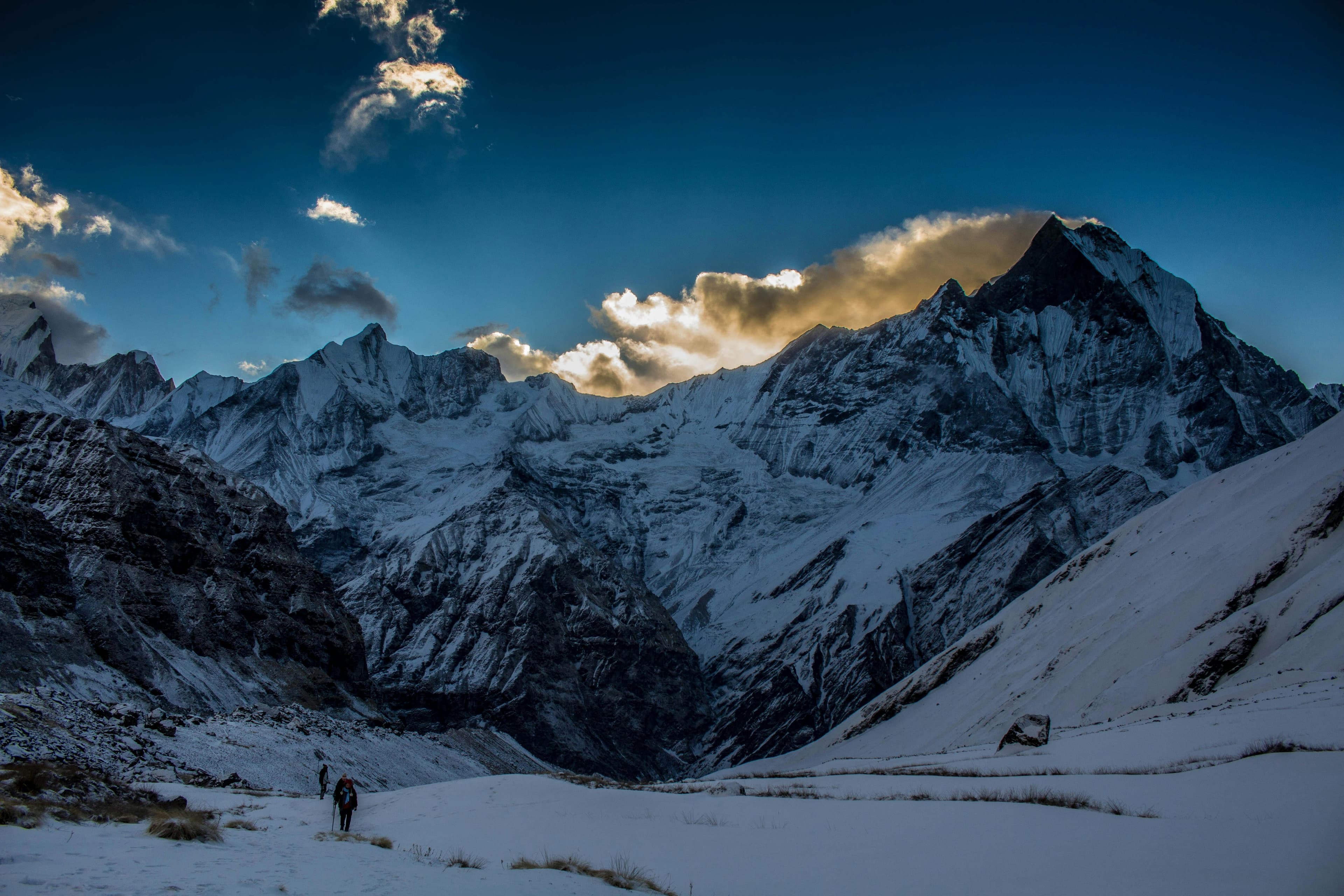
Annapurna Base Camp Trek: overview
- Duration
- 6–12 days (typically 7)
- Difficulty
- Moderate
- Max altitude
- 4,130 m · Annapurna Base Camp
- Start / finish
- Jhinu Danda (jeep from Pokhara) → Jhinu Danda (jeep to Pokhara)
- Best months
- Mar, Apr, Oct, Nov
- Sleep in
- Teahouse lodges all the way to ABC: twin rooms with shared toilets, thin walls and blankets. Above Chhomrong, lodge numbers are capped by ACAP, so in October and April rooms at Deurali, MBC and ABC fill by mid-afternoon and late arrivals may share dining-room floor space.
- Guide
- Licensed guide required
- Permits
- Annapurna Conservation Area Permit (ACAP), TIMS card
The Annapurna Base Camp trek follows the Modi Khola north from the Gurung village of Chhomrong into the Annapurna Sanctuary, a glacial basin enclosed by Annapurna I (8,091 m), Annapurna South (7,219 m), Hiunchuli (6,441 m), Gangapurna (7,455 m) and the fishtail summit of Machhapuchhre (6,993 m). From Pokhara the standard trek is 7 days: jeeps now reach Jhinu Danda, so you are in the mountains the same morning you leave the lake.
The walking is steady rather than technical. The hard part is the stone staircases below Chhomrong and Sinuwa, which you climb on the way in and again on the way out, plus the 900 m climb from Deurali to ABC on day 4. The altitude peaks at 4,130 m, low enough for most fit walkers with a sensible ascent, but high enough that headaches at MBC and ABC are common.
The classic ending is a soak in the hot springs below Jhinu Danda before the jeep back to Pokhara. If you have 10–11 days, start with Ghorepani and Poon Hill and cross via Tadapani to Chhomrong for the region's two best sunrises in one trip.
Highlights
- Sunrise at 4,130 m inside the Annapurna Sanctuary, with Annapurna I's south face straight above the lodges
- Machhapuchhre (6,993 m) seen close from Machhapuchhre Base Camp; the peak is sacred and has never been officially climbed
- Chhomrong, a Gurung village on a terraced spur with the first full view of Annapurna South and Hiunchuli
- Bamboo and rhododendron forest in the Modi Khola gorge, with waterfalls pouring off the valley walls
- Natural hot springs beside the Modi Khola below Jhinu Danda at the end of the trek
- Only a 3–4 h jeep ride from Pokhara to the trailhead, with no flights needed
- Easy to extend into a Poon Hill + ABC combination of 10–11 days
Day-by-day itinerary & route map
The standard 7-day itinerary from Pokhara. Tap any day, a marker on the map or a point on the altitude profile to follow the route. Walking times are for an average trekker at a steady pace, without long stops.
Route line and stops are approximate and drawn for planning — not for navigation. Terrain tiles © OpenTopoMap / OpenStreetMap contributors.
Show altitudes as a table
| Day | Route | Sleep | High point |
|---|---|---|---|
| 1 | Pokhara → Jhinu Danda (jeep) → Chhomrong | 2,170 m | — |
| 2 | Chhomrong → Sinuwa → Bamboo | 2,310 m | — |
| 3 | Bamboo → Dovan → Himalaya → Deurali | 3,230 m | — |
| 4 | Deurali → Machhapuchhre Base Camp → Annapurna Base Camp | 4,130 m | — |
| 5 | ABC sunrise → Bamboo | 2,310 m | — |
| 6 | Bamboo → Chhomrong → Jhinu Danda (hot springs) | 1,780 m | — |
| 7 | Jhinu Danda → Pokhara (jeep) | 820 m | — |
Day 1: Pokhara → Jhinu Danda (jeep) → Chhomrong
- Sleep altitude
- ▲ 2,170 m
- Time
- ⏱ 3–4 h drive + 2–2.5 h walk
- Distance
- ≈ 4 km
Drive west along the Baglung Highway to Nayapul, then up the rough road along the Modi Khola via Siwai to Jhinu Danda (1,780 m). From Jhinu it is a steep 400 m climb on stone steps to Chhomrong, the largest village in the upper valley. Annapurna South and Hiunchuli fill the view from the lodge terraces.
Overnight: Teahouse, Chhomrong
Local tip: After heavy rain jeeps may stop at Siwai or New Bridge; allow an extra 2–3 h of walking on the riverside trail if so.
Day 2: Chhomrong → Sinuwa → Bamboo
- Sleep altitude
- ▲ 2,310 m
- Time
- ⏱ 4–5 h walk
- Distance
- ≈ 8 km
Chhomrong's famous staircase drops about 300 m to the Chhomrong Khola suspension bridge, then climbs back up to Lower and Upper Sinuwa (2,340 m). The trail contours into the gorge through oak, rhododendron and bamboo forest, with a steep drop to Bamboo, a cluster of four lodges in the trees.
Overnight: Teahouse, Bamboo
Local tip: ACAP's checkpoint is in Chhomrong; have your permits ready. Lodges above here traditionally serve no meat, as the upper valley is considered sacred.
Day 3: Bamboo → Dovan → Himalaya → Deurali
- Sleep altitude
- ▲ 3,230 m
- Time
- ⏱ 5–6 h walk
- Distance
- ≈ 9 km
A steady climb up the east side of the gorge passes Dovan (2,600 m) and Himalaya (2,920 m), where the forest thins. Beyond the Hinku Cave overhang the valley opens and becomes rocky and cold. Deurali sits at the treeline and is noticeably chillier than Bamboo, so this is the night you'll need your warm layers.
Overnight: Teahouse, Deurali
Local tip: Aim to reach Deurali by early afternoon. Cloud usually fills the gorge after midday, and Deurali has only a handful of lodges.
Day 4: Deurali → Machhapuchhre Base Camp → Annapurna Base Camp
- Sleep altitude
- ▲ 4,130 m
- Time
- ⏱ 4–5 h walk
- Distance
- ≈ 6 km
The trail follows the Modi Khola moraine through the avalanche-prone section below MBC, then climbs gently into the Sanctuary to Machhapuchhre Base Camp (3,700 m). From MBC it is a slow 1.5–2 h over open grass and moraine to ABC, beside the Annapurna South Glacier. Stay out for sunset: the light turns Annapurna I and Machhapuchhre orange.
Overnight: Teahouse, Annapurna Base Camp
Local tip: If anyone in your group has a strong headache or is breathless at rest, sleep at MBC instead and walk up to ABC for sunrise.
Day 5: ABC sunrise → Bamboo
- Sleep altitude
- ▲ 2,310 m
- Time
- ⏱ 6–7 h walk
- Distance
- ≈ 15 km
Be outside by 5.30 am in autumn (earlier in spring) for sunrise on the full ring of peaks. Then retrace the route down past MBC, Deurali and Himalaya to Bamboo, a descent of 1,800 m that is hard on knees but quick. Dovan or Himalaya are good alternatives if you'd rather have a shorter day.
Overnight: Teahouse, Bamboo
Day 6: Bamboo → Chhomrong → Jhinu Danda (hot springs)
- Sleep altitude
- ▲ 1,780 m
- Time
- ⏱ 5–6 h walk
- Distance
- ≈ 10 km
Climb back up to Sinuwa, cross the Chhomrong Khola and face the long staircase up to Chhomrong, which is the toughest climb of the return. From Chhomrong it is all downhill to Jhinu Danda. The hot springs are about 20–25 minutes below the village by the river, with a small entry fee.
Overnight: Teahouse, Jhinu Danda
Local tip: Leave your big bag at the lodge and go down to the springs with a towel and head torch; the climb back up takes 30 minutes.
Day 7: Jhinu Danda → Pokhara (jeep)
- Sleep altitude
- ▲ 820 m
- Time
- ⏱ 3–4 h drive
Take a jeep from the Jhinu road head down the Modi Khola to Nayapul and back along the highway to Pokhara, arriving by early afternoon. If the road is closed, walk 1.5–2 h down the river to New Bridge or Siwai and pick up transport there.
Overnight: Hotel, Pokhara
Best time to trek
- Jan: not ideal
- Feb: possible
- Mar: best
- Apr: best
- May: possible
- Jun: not ideal
- Jul: not ideal
- Aug: not ideal
- Sep: possible
- Oct: best
- Nov: best
- Dec: possible
Not sure which season suits you? Our month-by-month guide to trekking in Nepal covers weather, crowds and festivals.
Permits, fees & the guide rule
| Permit | Cost (foreigners) | Notes |
|---|---|---|
| Annapurna Conservation Area Permit (ACAP) | NPR 3,000 (≈ USD 22) | SAARC nationals NPR 1,000. Issued in Pokhara (Nepal Tourism Board office, Damside) or Kathmandu (Bhrikutimandap); carry it with your passport as it is checked several times. |
| TIMS card | NPR 2,000 (≈ USD 15) | Issued through a registered trekking agency, together with your licensed guide. |
Licensed guide required for foreign trekkers
Since 1 April 2023 the Nepal Tourism Board requires foreign trekkers to walk with a licensed guide arranged through a registered agency in conservation areas, including the Annapurna Conservation Area. Enforcement at Annapurna checkpoints has been inconsistent, but plan on a guide (or at minimum a licensed porter-guide) rather than counting on walking alone, and check the current rules before you travel.
Fees as of September 2026. Nepal changes permit rules and prices from time to time — confirm before you travel. Full details in our Nepal trekking permits guide.
Getting there
From Pokhara
Shared jeeps to Jhinu Danda and Siwai leave from the Baglung bus park in the morning; most trekkers take a private jeep from Lakeside (3–4 h). To start via Ghandruk instead, jeeps run to Ghandruk in about 3 h, then it is one extra day's walk via Komrong Danda to Chhomrong. For the Poon Hill + ABC combination, drive to Nayapul or Ulleri (1.5–2.5 h).
From Kathmandu
Take a tourist bus to Pokhara (USD 10–25, 6–8 h) or fly (USD 100–130, 25 min), and spend a night in Pokhara to get your permits and meet your guide. There is no practical direct connection from Kathmandu to the trailhead in one day.
Getting back
Jeeps run from Jhinu Danda and Siwai back to Pokhara, and your guide can book one the night before. If you finish at Ghandruk or Nayapul, taxis and local buses are available all day to Pokhara (1.5–3 h).
How much does the ABC trek cost?
Move the sliders to estimate your own trip. Typical teahouse spend on this route is USD 30–50 per person per day for a room and three meals; a licensed guide costs USD 25–35 a day and a porter USD 18–25.
Estimated cost per person
USD 371
+ about USD 13 in tips for your staff
- Teahouse room & 3 meals × 7 daysUSD 210
- PermitsUSD 36
- Transport to & from trailheadUSD 20
- Licensed guide (shared by 2)USD 105
Do-it-yourself estimate for the Annapurna Base Camp Trek, from typical 2026 teahouse prices. Excludes flights to Nepal, visa, insurance, gear, drinks, hot showers and charging fees.
- Lodge and menu prices are set by village management committees and rise the higher you go: a dal bhat that costs NPR 600–700 in Chhomrong can cost NPR 1,000–1,200 at ABC.
- Hot showers, charging and Wi-Fi are extra above Chhomrong (typically NPR 200–500 each).
- A private jeep Pokhara–Jhinu costs roughly USD 90–130 per vehicle each way; shared seats are much cheaper when available.
- Budget USD 5–10 per day for boiled or filtered water, snacks and hot drinks.
- Tips for guide and porter are customary: about 10–15% of their total wages.
Important things to know
Altitude & acclimatisation
The ascent from Deurali (3,230 m) to ABC (4,130 m) is about 900 m in one day, more than the usual 500 m guideline above 3,000 m. Most fit trekkers manage it, but mild headaches and poor sleep at ABC are common. If symptoms worsen (vomiting, confusion, breathlessness at rest), descend; you lose 1,000 m in 3–4 h. Sleeping at MBC first is the easy way to add a buffer.
Avalanche risk: Deurali to MBC
The trail between Himalaya, Deurali and MBC runs along the floor of a narrow gorge beneath steep slopes, and avalanches have killed trekkers here (notably in January 2020). Risk is highest from January to April after heavy snowfall. Follow ACAP and lodge advice, take the alternative east-bank trail when it's marked, cross early in the morning, and do not stop in marked avalanche zones.
Trail conditions & roads
There are no roads above Jhinu Danda. The trail is well built but has thousands of stone steps, especially around Chhomrong and Sinuwa, so trekking poles help on the descent. In winter and early spring expect snow and ice above Deurali; microspikes are useful from December to March.
Water & food
Every lodge sells boiled or filtered water, and many villages have ACAP safe-drinking-water refill stations, which are cheaper and avoid plastic. Menus are the standard teahouse list (dal bhat, noodles, pasta, momos, pancakes). Above Chhomrong there is traditionally no meat, and eggs and fresh vegetables get pricier with height.
Charging, Wi-Fi & mobile network
Chhomrong and Jhinu have good Ncell and NTC 4G/3G coverage. Coverage becomes patchy in the gorge beyond Sinuwa, with signal returning weakly at MBC and ABC on NTC. Most lodges sell Wi-Fi, but in the upper valley it is slow and often down. Charging costs extra above Chhomrong, so bring a 10,000–20,000 mAh power bank.
Money & ATMs
Do not count on an ATM after Pokhara. Carry enough Nepali rupees in cash for the whole trek plus a buffer (roughly NPR 5,000–7,000 per person per day at upper-lodge prices). Cards are almost never accepted on the trail.
Weather & best months
October and November bring the clearest skies; March and April bring rhododendrons, with haze and afternoon cloud. December to February is cold (−10 °C at ABC at night) and quiet, with avalanche risk. June to August is monsoon, with leeches below Deurali, landslides on the jeep road and few clear mornings.
Rescue & insurance
Helicopters can land at ABC, MBC, Deurali and Chhomrong, and evacuation typically costs USD 3,000–6,000+. Your insurance must cover trekking to at least 4,200 m and helicopter rescue. Make sure your guide has the policy number and emergency phone number before you leave Pokhara.
Responsible trekking
Refill bottles instead of buying plastic, and carry your batteries and wrappers back to Pokhara. The Sanctuary is sacred to the Gurung community, so don't take meat past Chhomrong and don't approach Machhapuchhre beyond the marked viewpoints.
Tips for solo trekkers
- ABC is one of the busiest treks in Nepal, so from October to November and March to April you'll share every lodge with other trekkers and rarely walk more than 10 minutes without seeing someone.
- Plan on a licensed guide or porter-guide. ACAP checkpoints at Chhomrong may ask to see your guide, and a guide also secures scarce beds at Deurali, MBC and ABC in peak season.
- Joining a small group from Pokhara is the cheapest way for a solo traveller to share guide and jeep costs.
- Don't cross the Deurali–MBC section alone after fresh snow, and never after midday in late winter or spring.
- Women travelling alone generally find this trail safe and lodges welcoming. Choose lodges where other trekkers are staying, and ask your agency for a female guide if you'd prefer one; several are working in Pokhara.
- Tell your lodge the next day's destination each morning. Owners along the valley phone ahead, which makes it easy to trace a missing trekker.
- Avoid January–April if you're alone and inexperienced in snow. December and the monsoon are quiet, so you may have lodges to yourself.
- Carry a whistle and head torch, and don't walk the gorge in the dark. A slip on wet steps is the most common injury here.
More in our complete guide to solo trekking in Nepal.
What to pack for this trek
- Sleeping bag rated to about −10 °C (lodges at MBC and ABC are unheated)
- Down jacket for the evenings and sunrise at ABC
- Trekking poles for the Chhomrong and Sinuwa staircases
- Microspikes from December to March for ice above Deurali
- Swimwear or quick-dry shorts for the Jhinu hot springs
- Water filter or purification tablets to use the ACAP refill stations
- Sunglasses and SPF 50 sunscreen; glare off snow at ABC is strong
- 10,000–20,000 mAh power bank
- Leech socks or salt in June–September
The basics are the same for every Nepal trek — see our interactive packing checklist.
Route options & variations
Poon Hill + ABC (10–11 days)
Drive to Nayapul or Ulleri, then walk up to Ghorepani, catch sunrise from Poon Hill (3,210 m), and cross via Deurali pass and Tadapani to Chhomrong, where you join the ABC route. Exit via Jhinu. This combination gives you the Dhaulagiri panorama from Poon Hill and the Sanctuary, with better acclimatisation from the extra days in the middle hills.
Via Ghandruk (8 days)
Drive to Ghandruk (1,940 m), explore the Gurung museum and stone lanes, then walk via Komrong Danda (2,250 m) to Chhomrong the next day. The rest of the itinerary is the same, and you still exit via Jhinu.
Fast ABC (6 days)
Walk Chhomrong to Deurali in one long day, then descend from ABC to Sinuwa or Chhomrong. This works only for very fit trekkers with no altitude problems, and it leaves no buffer for weather.
Add Mardi Himal as a separate trek
There is no trekkers' trail across the Mardi Himal ridge into the Sanctuary. Walkers who want both usually do Mardi Himal (5 days) as a separate trip from Pokhara before or after ABC.
Our recommendation
Book the Annapurna Base Camp Trek with Mantra Mountain
We are a local operator based in Pokhara — the gateway to most of the treks in this guide. Booking with us means a government-licensed guide, permits and TIMS arranged before you arrive, transport from your Pokhara hotel to the trailhead, and a team on the phone if plans change on the trail. Foreign trekkers must trek this route with a licensed guide anyway, so it pays to choose one you trust.
- Licensed, English-speaking local guides
- Permits & TIMS handled for you
- Solo travellers welcome
- Itineraries adjusted to your pace and dates
ABC FAQ
How difficult is the Annapurna Base Camp trek?
ABC is a moderate trek: 4–7 hours of walking a day on good trails, but with long stone staircases and a high point of 4,130 m. Anyone who can hike 15 km with 800 m of ascent on consecutive days will be fine. Most people find the altitude on the last day and the descent on the stairs harder than the distances.
How many days do I need for Annapurna Base Camp?
Seven days from Pokhara back to Pokhara is standard now that jeeps reach Jhinu Danda. Allow 8 days via Ghandruk, or 10–11 days to combine ABC with Poon Hill. Add a spare day for weather or altitude if your flight home is tight.
Can I do the Annapurna Base Camp trek without a guide?
Officially no. Since April 2023 foreign trekkers in the Annapurna Conservation Area must walk with a licensed guide arranged through a registered agency. Checks at Chhomrong have been inconsistent, but rules can be enforced at any time, so plan on at least a licensed porter-guide.
How much does the Annapurna Base Camp trek cost?
Independent costs run at USD 30–50 a day for lodges and food, plus USD 25–35 a day for a guide, ACAP (NPR 3,000), TIMS (NPR 2,000) and the jeep from Pokhara. A 7-day trek typically comes to USD 450–700 per person with a guide, depending on group size and comfort.
What is the best time for the Annapurna Base Camp trek?
Mid-October to November gives the clearest views and stable weather. March and April are the next best, with rhododendrons in flower but more afternoon cloud. From January to April, check avalanche conditions between Deurali and MBC before you set off.
Is there Wi-Fi and phone signal on the ABC trek?
Most lodges sell Wi-Fi, and Chhomrong and Jhinu have 4G on NTC and Ncell. Between Bamboo and Deurali signal is weak or absent, and Wi-Fi at MBC and ABC is slow and unreliable. Tell family you may be offline for 2–3 days.
Do I need a permit for Annapurna Base Camp?
Yes. Foreigners need the ACAP (NPR 3,000; SAARC NPR 1,000) and a TIMS card (NPR 2,000) issued through a registered agency. Permits are checked in Chhomrong and sometimes at Jhinu or Ghandruk.
Is Annapurna Base Camp good for beginners?
Yes, for fit beginners with a guide. It is one of the best first high treks in Nepal because lodges are frequent and you can descend quickly if the altitude bothers you. Do some stair training before you go.
Is the ABC trek dangerous in winter?
The main danger is avalanches in the gorge between Himalaya, Deurali and MBC, especially from January to April after snowfall. With a guide who follows lodge and ACAP advice, walking in clear weather is reasonable, but be ready to wait or turn back after heavy snow.
Still have questions? Browse 80+ answers about trekking in Nepal.
Ask us about the ABC trek
Tell us your dates, group size and fitness — our Pokhara team replies by email with honest advice, even if you decide to trek with someone else.