
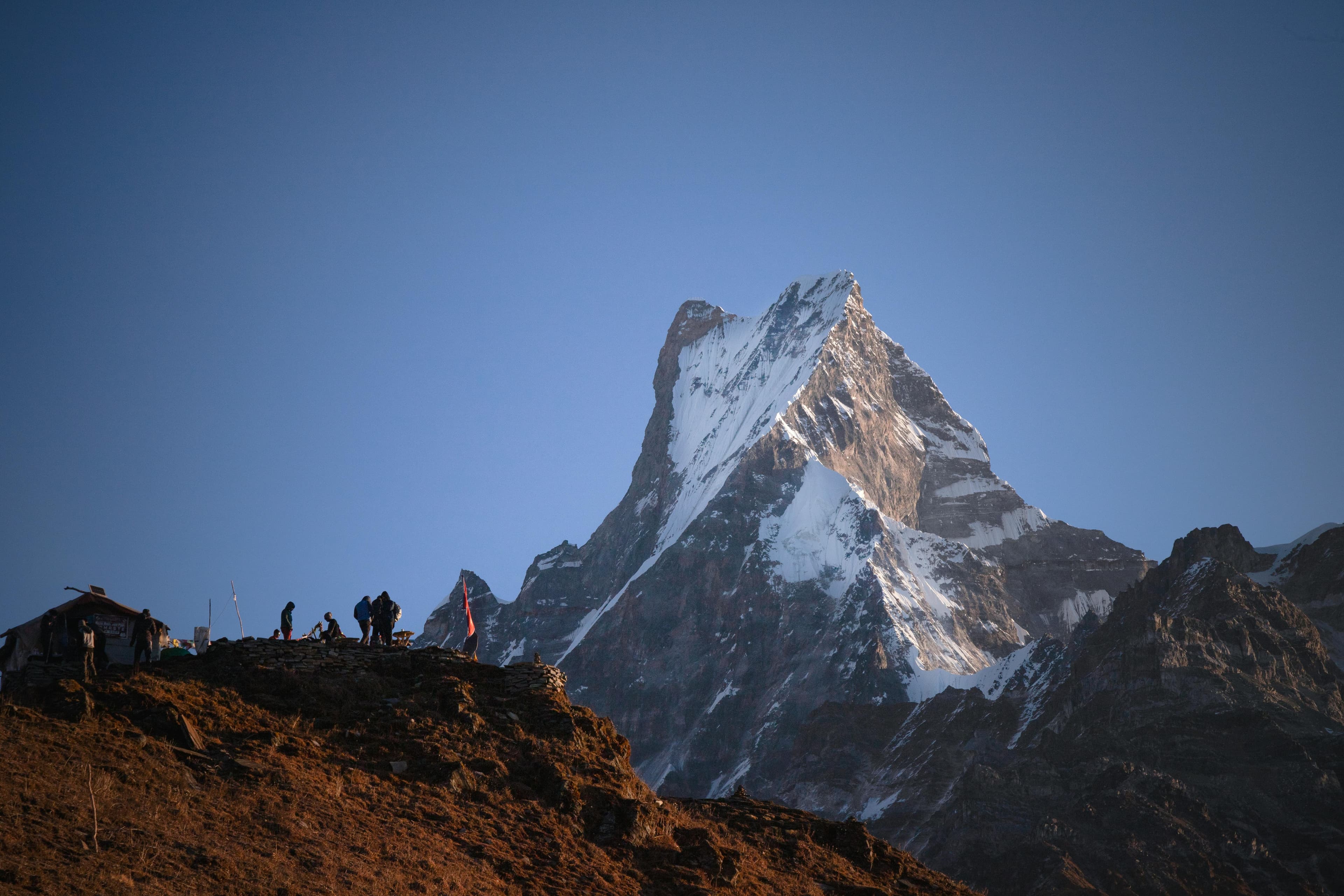
Mardi Himal Trek: overview
- Duration
- 4–7 days (typically 5)
- Difficulty
- Moderate
- Max altitude
- 4,500 m · Mardi Himal Base Camp (optional; Upper View Point 4,200 m)
- Start / finish
- Kande (taxi from Pokhara) → Siding (jeep to Pokhara)
- Best months
- Mar, Apr, Oct, Nov
- Sleep in
- Simple teahouses at Deurali, Forest Camp, Rest Camp, Low Camp, Badal Danda and High Camp, with twin and triple rooms and shared toilets. High Camp has several lodges but fills quickly in October, so book through your guide. There are no lodges above High Camp.
- Guide
- Licensed guide required
- Permits
- Annapurna Conservation Area Permit (ACAP), TIMS card
Mardi Himal climbs a single forested ridge that runs straight towards Machhapuchhre (6,993 m), the fishtail peak above Pokhara. It opened to trekkers only in 2012, and it has become the favourite short high trek from Pokhara: 5 days from lake to ridge and back, with no flights and only an hour's drive to the trailhead at Kande.
The first two days are in dense oak and rhododendron forest. Above Low Camp (2,970 m) the trees give way and the path follows the crest of the ridge, with Annapurna South, Hiunchuli and Mardi Himal (5,587 m) ahead and the Pokhara valley behind. The summit day is a pre-dawn climb from High Camp (3,580 m) to the Upper View Point (about 4,200 m) and, for strong walkers, on to Mardi Himal Base Camp at about 4,500 m.
The ridge is steep and exposed above High Camp, and cloud often rolls in by 10 am, so start early and take a guide who knows the trail. Descending east to Siding lets you finish via a different valley and a jeep road back to Pokhara.
Highlights
- Close-up views of Machhapuchhre's (6,993 m) twin summits from the ridge above High Camp
- Sunrise from the Upper View Point (about 4,200 m) over Annapurna South, Hiunchuli and Mardi Himal
- Moss-covered rhododendron forest between Deurali and Low Camp, red with flowers in March and April
- Ridge walking above the clouds, with the Pokhara valley and Phewa Lake visible on clear mornings
- Only 1 hour by road from Pokhara to the trailhead, which makes it one of the easiest high treks to fit into a short trip
- Quieter than ABC or Poon Hill, with small lodges and a descent through Gurung farming villages at Siding
Day-by-day itinerary & route map
The standard 5-day itinerary from Pokhara. Tap any day, a marker on the map or a point on the altitude profile to follow the route. Walking times are for an average trekker at a steady pace, without long stops.
Route line and stops are approximate and drawn for planning — not for navigation. Terrain tiles © OpenTopoMap / OpenStreetMap contributors.
Show altitudes as a table
| Day | Route | Sleep | High point |
|---|---|---|---|
| 1 | Pokhara → Kande → Australian Camp → Pitam Deurali → Forest Camp | 2,520 m | — |
| 2 | Forest Camp → Rest Camp → Low Camp | 2,970 m | — |
| 3 | Low Camp → Badal Danda → High Camp | 3,580 m | — |
| 4 | High Camp → Upper View Point → (Mardi Himal Base Camp) → Low Camp | 2,970 m | 4,500 m (Mardi Himal Base Camp (Upper View Point ≈ 4,200 m)) |
| 5 | Low Camp → Siding → Pokhara (jeep) | 820 m | — |
Day 1: Pokhara → Kande → Australian Camp → Pitam Deurali → Forest Camp
- Sleep altitude
- ▲ 2,520 m
- Time
- ⏱ 1 h drive + 5–6 h walk
- Distance
- ≈ 11 km
Drive to Kande (1,770 m) on the Baglung Highway and climb 1 h to Australian Camp (2,060 m) for the first view of the Annapurnas. Continue through Pothana (1,890 m), where ACAP checks permits, to Pitam Deurali (2,100 m), where the Mardi trail leaves the main route. The final 3 h climb through dense forest has no villages until Forest Camp (also called Kokar).
Overnight: Teahouse, Forest Camp
Local tip: Carry 2 litres of water and lunch from Deurali; there is no reliable water or tea shop for most of the forest section.
Day 2: Forest Camp → Rest Camp → Low Camp
- Sleep altitude
- ▲ 2,970 m
- Time
- ⏱ 3–4 h walk
- Distance
- ≈ 5 km
A steady climb along the ridge through tall rhododendron and oak, passing the lodges at Rest Camp (2,650 m). Low Camp sits in a clearing where Machhapuchhre appears suddenly, close and huge, above the trees. The short day is intentional for acclimatisation, so enjoy the afternoon view.
Overnight: Teahouse, Low Camp
Local tip: Watch for Danfe (Himalayan monal) and langur monkeys in the forest early in the morning.
Day 3: Low Camp → Badal Danda → High Camp
- Sleep altitude
- ▲ 3,580 m
- Time
- ⏱ 3–4 h walk
- Distance
- ≈ 5 km
Above Low Camp the forest thins to dwarf rhododendron, and the trail climbs onto the open crest at Badal Danda (3,210 m, 'cloud ridge'), where there are a couple of lodges. From here it is open ridge walking with big views on both sides to High Camp. Afternoons are often misty, and the temperature drops sharply after sunset.
Overnight: Teahouse, High Camp
Day 4: High Camp → Upper View Point → (Mardi Himal Base Camp) → Low Camp
- Sleep altitude
- ▲ 2,970 m
- High point
- Max 4,500 m · Mardi Himal Base Camp (Upper View Point ≈ 4,200 m)
- Time
- ⏱ 7–10 h walk
- Distance
- ≈ 14 km
Leave High Camp at 4–5 am with head torches and climb the steep, narrow ridge for 2–3 h to the Upper View Point for sunrise on Machhapuchhre, Mardi Himal, Hiunchuli and Annapurna South. Strong walkers continue 1.5–2 h over rough moraine to Mardi Himal Base Camp (about 4,500 m). Return to High Camp for a late breakfast, then descend to Low Camp.
Overnight: Teahouse, Low Camp
Local tip: The ridge above High Camp is exposed, and people have gone missing here in fog. Turn round if cloud closes in, and don't go above High Camp without a guide after snow.
Day 5: Low Camp → Siding → Pokhara (jeep)
- Sleep altitude
- ▲ 820 m
- Time
- ⏱ 3–4 h walk + 2.5–3 h drive
- Distance
- ≈ 8 km
From Low Camp take the steep eastern trail down through forest and terraced fields to Siding (about 1,750 m), a Gurung village in the Mardi Khola valley. Jeeps run from Siding down the rough road via Lwang and Hemja to Pokhara.
Overnight: Hotel, Pokhara
Local tip: Order your jeep from Low Camp the evening before; in the dry season Siding's road is fine, but after rain it can close.
Best time to trek
- Jan: not ideal
- Feb: possible
- Mar: best
- Apr: best
- May: possible
- Jun: not ideal
- Jul: not ideal
- Aug: not ideal
- Sep: possible
- Oct: best
- Nov: best
- Dec: possible
Not sure which season suits you? Our month-by-month guide to trekking in Nepal covers weather, crowds and festivals.
Permits, fees & the guide rule
| Permit | Cost (foreigners) | Notes |
|---|---|---|
| Annapurna Conservation Area Permit (ACAP) | NPR 3,000 (≈ USD 22) | SAARC nationals NPR 1,000. Issued in Pokhara (Nepal Tourism Board office, Damside) or Kathmandu (Bhrikutimandap); carry it with your passport as it is checked several times. |
| TIMS card | NPR 2,000 (≈ USD 15) | Issued through a registered trekking agency, together with your licensed guide. |
Licensed guide required for foreign trekkers
Since 1 April 2023 the Nepal Tourism Board requires foreign trekkers to walk with a licensed guide arranged through a registered agency in conservation areas, including the Annapurna Conservation Area. Enforcement at Annapurna checkpoints has been inconsistent, but plan on a guide (or at minimum a licensed porter-guide) rather than counting on walking alone, and check the current rules before you travel.
Fees as of September 2026. Nepal changes permit rules and prices from time to time — confirm before you travel. Full details in our Nepal trekking permits guide.
Getting there
From Pokhara
Kande is 45 minutes to 1 hour from Lakeside by taxi on the Baglung Highway, or you can take a local bus from the Baglung bus park. An alternative start is Dhampus Phedi (40 minutes), climbing through Dhampus to Pothana and Pitam Deurali, where it joins the Kande route.
From Kathmandu
Take a tourist bus (USD 10–25, 6–8 h) or flight (USD 100–130, 25 min) to Pokhara and spend a night there to arrange permits and your guide. Starting the trek on the same day as the bus from Kathmandu isn't realistic.
Getting back
The standard exit is a jeep from Siding to Pokhara (2.5–3 h). You can also retrace your steps to Kande or Dhampus Phedi (one long day from Low Camp) and take a taxi from the highway.
How much does the Mardi Himal trek cost?
Move the sliders to estimate your own trip. Typical teahouse spend on this route is USD 30–45 per person per day for a room and three meals; a licensed guide costs USD 25–35 a day and a porter USD 18–25.
Estimated cost per person
USD 276
+ about USD 9 in tips for your staff
- Teahouse room & 3 meals × 5 daysUSD 150
- PermitsUSD 36
- Transport to & from trailheadUSD 15
- Licensed guide (shared by 2)USD 75
Do-it-yourself estimate for the Mardi Himal Trek, from typical 2026 teahouse prices. Excludes flights to Nepal, visa, insurance, gear, drinks, hot showers and charging fees.
- A taxi from Pokhara to Kande costs roughly USD 15–25 per car.
- A jeep from Siding to Pokhara costs about USD 60–100 per vehicle; shared seats are sometimes available.
- Prices at High Camp are the highest on the trek, because everything is carried up by porters or mules.
- Hot showers are available at most lodges up to Low Camp for a small fee, but rarely at High Camp.
Important things to know
Altitude & acclimatisation
You gain about 1,800 m in three days from Kande to High Camp, then climb another 600–900 m on summit morning. The profile is steep but brief, and most people cope well, with mild headaches at High Camp being common. If you feel unwell at High Camp, skip the base camp extension and be content with the lower viewpoint at about 3,850 m.
Trail conditions & exposure
Below Low Camp the trail is a forest path, muddy after rain with roots and steps. Above High Camp it is steep, loose and narrow on the ridge crest, with drops on both sides; in December–March it is often snow-covered and icy. Poles are very useful and microspikes are advisable in winter.
Weather & fog
Mornings are usually clear, and cloud builds from mid-morning, so the summit push starts before dawn. In fog the ridge above High Camp is disorienting, and there have been deaths and missing-person searches after trekkers strayed off the ridge. From June to August the ridge is wet and mostly in cloud, with leeches in the forest.
Water & food
Buy boiled or filtered water at lodges, or treat stream water yourself. Between Pitam Deurali and Forest Camp there is no reliable water. Menus are shorter than on ABC but cover dal bhat, noodles, fried rice, porridge and tea at every camp.
Charging, Wi-Fi & mobile network
Because the ridge faces Pokhara, mobile coverage is surprisingly good: NTC and Ncell usually work at Low Camp, Badal Danda and High Camp, with patchy gaps in the forest. Many lodges sell Wi-Fi. Charging is extra at the upper camps, so bring a power bank.
Money & ATMs
There are no ATMs on the trek. Take enough cash from Pokhara for all meals, water, charging and the jeep out, plus a spare NPR 5,000.
Rescue & insurance
Helicopters can land near High Camp and Low Camp in clear weather, and evacuation typically costs USD 3,000–6,000+. Your insurance must cover trekking to 4,500 m and helicopter rescue. The good phone signal makes calling for help easier here than on most treks.
Responsible trekking
The lodges are small and waste has to be carried down, so pack out batteries, wrappers and plastic bottles. Stay on the ridge path to avoid eroding the fragile alpine turf around High Camp.
Tips for solo trekkers
- Don't walk above High Camp alone. The ridge is where people get lost in fog, and there is no lodge to shelter in above it.
- A licensed guide is required in the Annapurna Conservation Area. On Mardi a guide also books your High Camp bed, which matters in October and November.
- Solo trekkers easily meet others at Low Camp and High Camp, where everyone leaves together at 4–5 am for the View Point.
- The forest section between Pitam Deurali and Forest Camp is long and quiet. Start it before 11 am so you aren't walking alone in the forest at dusk.
- Women travelling alone usually find the lodges friendly and family-run. Choose rooms with an inside lock and share the pre-dawn summit walk with other groups.
- Avoid the High Camp–View Point section from December to February unless you have microspikes and a guide, and skip it in the monsoon when you'll see nothing.
- Tell your lodge owner your planned turnaround time before you leave for the View Point.
More in our complete guide to solo trekking in Nepal.
What to pack for this trek
- Head torch with spare batteries for the 4–5 am start from High Camp
- Microspikes from December to March for the icy ridge above High Camp
- Trekking poles for the steep, loose descent from the View Point and down to Siding
- Windproof shell and warm gloves; the ridge is exposed to wind at sunrise
- Sleeping bag rated to about −10 °C for High Camp
- 2-litre water capacity for the dry forest stretch below Forest Camp
- Snacks for summit morning; lodges at High Camp serve breakfast only after you return
- Leech socks for the forest from June to September
The basics are the same for every Nepal trek — see our interactive packing checklist.
Route options & variations
Mardi Himal in 4 days
Walk Kande to Forest Camp, then go straight from Forest Camp to High Camp on day 2 (6–7 h), climb to the View Point on day 3 and descend to Siding, then return to Pokhara on day 4. This works for fit walkers, but you gain altitude quickly, so there's less room for bad weather.
Mardi Himal with Australian Camp and Dhampus (6–7 days)
Add a night at Australian Camp at the start for sunset and sunrise over the Annapurnas, and return by the same ridge to Dhampus instead of Siding. This version is gentler on acclimatisation and good for families with teenagers.
East ridge via Sidhing and Mardi Khola
Some itineraries go up from Siding to Low Camp and come down to Kande, reversing the standard route. The ascent from Siding is steeper and hotter, so most guides prefer to use it only for the descent.
Our recommendation
Book the Mardi Himal Trek with Mantra Mountain
We are a local operator based in Pokhara — the gateway to most of the treks in this guide. Booking with us means a government-licensed guide, permits and TIMS arranged before you arrive, transport from your Pokhara hotel to the trailhead, and a team on the phone if plans change on the trail. Foreign trekkers must trek this route with a licensed guide anyway, so it pays to choose one you trust.
- Licensed, English-speaking local guides
- Permits & TIMS handled for you
- Solo travellers welcome
- Itineraries adjusted to your pace and dates
Mardi Himal FAQ
How difficult is the Mardi Himal trek?
Moderate. Daily walks are short (3–6 h), but the ascent is steep, and summit day involves 7–10 hours on an exposed ridge up to 4,200–4,500 m. Reasonable fitness and good boots are enough; no technical skills are needed outside snowy months.
How many days do I need for Mardi Himal?
Five days from Pokhara back to Pokhara is standard. Fit walkers can do it in 4 days, and 6–7 days allows a night at Australian Camp or a spare weather day.
Can I do the Mardi Himal trek without a guide?
Officially, foreigners need a licensed guide in the Annapurna Conservation Area since April 2023. Checks on Mardi have been inconsistent, but it is the trek near Pokhara where a guide matters most, because the ridge above High Camp is easy to lose in fog.
How much does the Mardi Himal trek cost?
Budget USD 30–45 a day for food and lodging, USD 25–35 a day for a guide, ACAP (NPR 3,000), TIMS (NPR 2,000) and USD 15–60 for transport. A 5-day trek with a guide typically comes to USD 300–500 per person.
What is the best time for the Mardi Himal trek?
October and November give the clearest views, and March and April give rhododendrons. December to February is clear but the ridge above High Camp is often icy, and the monsoon (June–August) usually hides the mountains.
Is there Wi-Fi on the Mardi Himal trek?
Yes, most lodges sell Wi-Fi. NTC and Ncell mobile data usually works at Low Camp and High Camp because the ridge faces Pokhara, but expect gaps in the forest.
Do I need a permit for Mardi Himal?
Yes. You need the ACAP (NPR 3,000; SAARC NPR 1,000) and a TIMS card (NPR 2,000), with checks at Pothana or Forest Camp.
Is Mardi Himal good for beginners?
Yes, for fit beginners with a guide in spring or autumn. It is short and close to Pokhara, but the steep ridge makes it more demanding than Poon Hill, so it suits people who already walk in hills.
What is the difference between Mardi Himal View Point and Base Camp?
The Upper View Point (about 4,200 m) is 2–3 h above High Camp and is where most trekkers turn round. Mardi Himal Base Camp (about 4,500 m) is another 1.5–2 h further over rough ground, with a closer view of Mardi Himal and the Sanctuary rim. Only attempt it in clear weather and good health.
Still have questions? Browse 80+ answers about trekking in Nepal.
Ask us about the Mardi Himal trek
Tell us your dates, group size and fitness — our Pokhara team replies by email with honest advice, even if you decide to trek with someone else.