
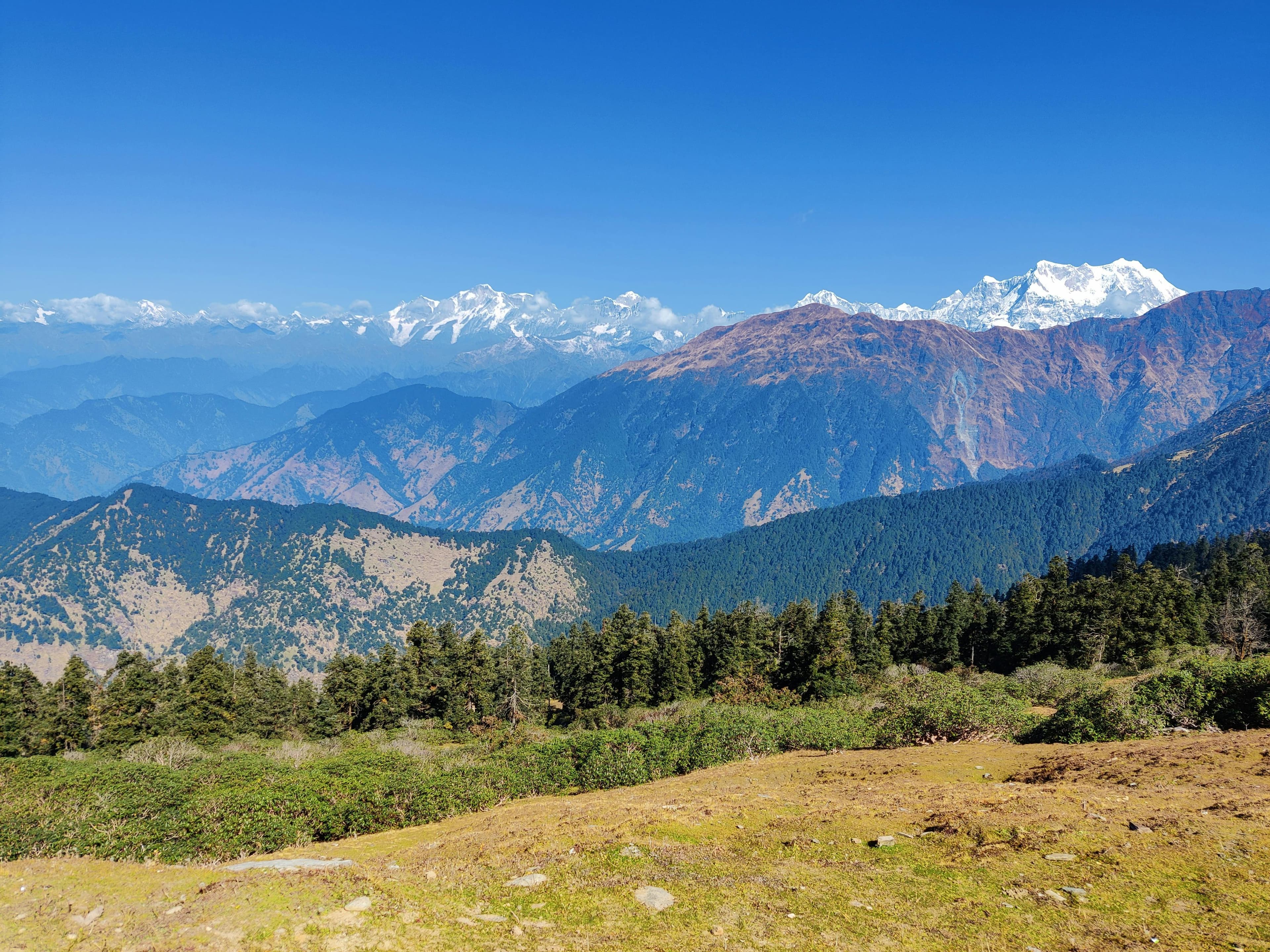
Ghorepani Poon Hill Trek: overview
- Duration
- 3–5 days (typically 4)
- Difficulty
- Moderate
- Max altitude
- 3,210 m · Poon Hill
- Start / finish
- Nayapul (1.5–2 h drive from Pokhara) → Ghandruk, then jeep back to Pokhara
- Best months
- Mar, Apr, Oct, Nov
- Sleep in
- Teahouses (lodges) in every overnight village, with twin rooms, shared or attached bathrooms and a heated dining room. Ghorepani has 30+ lodges; hot showers are gas or solar, and blankets are provided.
- Guide
- Licensed guide required
- Permits
- ACAP (Annapurna Conservation Area Permit), TIMS card
Ghorepani Poon Hill is the classic short trek from Pokhara: a 4-day loop that climbs the stone staircase above Ulleri to Ghorepani (2,860 m), catches sunrise from Poon Hill (3,210 m) over Dhaulagiri (8,167 m), Annapurna South, Annapurna I and Machhapuchhre, then crosses a forested ridge to Tadapani and drops into the Gurung village of Ghandruk.
The altitude is low enough that acute mountain sickness is rare, but the trek is not flat. Day 1 and 2 involve around 1,800 m of ascent in total, including several thousand stone steps between Tikhedhunga and Ulleri, and the descent to Ghandruk is hard on knees. Walking days are 4–7 hours, and most people with regular exercise manage comfortably.
Roads now reach Ulleri on one side and Ghandruk on the other, so you can shorten the trek to 3 days by jeep or stretch it to 5 by walking the full way from Nayapul. Mantra Mountain is based in Pokhara and runs this trek.
Highlights
- Sunrise from Poon Hill (3,210 m) over Dhaulagiri, Tukuche Peak, Nilgiri, Annapurna South, Annapurna I, Hiunchuli and Machhapuchhre
- Rhododendron forest between Ghorepani and Tadapani, in full red and pink bloom from mid-March to April
- The Magar village of Ulleri, perched on a staircase of stone steps above the Bhurungdi Khola
- Face-on view of Annapurna South and Machhapuchhre from Tadapani at sunset and sunrise
- Ghandruk, one of the largest Gurung villages in Nepal, with slate-roofed houses and the Old Gurung Museum
- Maximum altitude of 3,210 m, so a real Himalayan trek with little altitude risk
- Short enough to fit between arriving in Pokhara and a bigger trek or flight home
Day-by-day itinerary & route map
The standard 4-day itinerary from Pokhara. Tap any day, a marker on the map or a point on the altitude profile to follow the route. Walking times are for an average trekker at a steady pace, without long stops.
Route line and stops are approximate and drawn for planning — not for navigation. Terrain tiles © OpenTopoMap / OpenStreetMap contributors.
Show altitudes as a table
| Day | Route | Sleep | High point |
|---|---|---|---|
| 1 | Pokhara → Nayapul → Birethanti → Tikhedhunga → Ulleri | 2,050 m | — |
| 2 | Ulleri → Banthanti → Nangethanti → Ghorepani | 2,860 m | — |
| 3 | Poon Hill sunrise → Deurali → Banthanti → Tadapani | 2,630 m | 3,210 m (Poon Hill) |
| 4 | Tadapani → Ghandruk → jeep to Pokhara | 820 m | — |
Day 1: Pokhara → Nayapul → Birethanti → Tikhedhunga → Ulleri
- Sleep altitude
- ▲ 2,050 m
- Time
- ⏱ 1.5–2 h drive + 5–6 h walk
- Distance
- ≈ 11 km
Drive west on the Baglung highway to Nayapul (1,070 m) and walk 20 minutes to Birethanti (1,025 m), where your ACAP permit is checked. The trail, now partly a dirt road, follows the Bhurungdi Khola past Hile to Tikhedhunga (1,540 m). From the iron bridge beyond Tikhedhunga the famous stone staircase climbs about 500 m in 1.5–2 hours to Ulleri.
Overnight: Teahouse, Ulleri
Local tip: Most groups now take a jeep from Nayapul to Hile or Tikhedhunga, which saves 2–3 hours of dusty road walking. Tackle the Ulleri steps slowly in the cool of late afternoon.
Day 2: Ulleri → Banthanti → Nangethanti → Ghorepani
- Sleep altitude
- ▲ 2,860 m
- Time
- ⏱ 4–5 h walk
- Distance
- ≈ 8 km
A steady 800 m climb, first through terraces then into oak and rhododendron forest past the small lodge stops of Banthanti (2,250 m) and Nangethanti (2,460 m). Ghorepani sits on a ridge crest and is split into lower Ghorepani and the main upper village near the Poon Hill trail gate. Arrive by early afternoon with time for a hot shower before the cold evening.
Overnight: Teahouse, Ghorepani
Local tip: Book a room in upper Ghorepani: it saves 10 minutes of climbing in the dark at 5 am.
Day 3: Poon Hill sunrise → Deurali → Banthanti → Tadapani
- Sleep altitude
- ▲ 2,630 m
- High point
- Max 3,210 m · Poon Hill
- Time
- ⏱ 1.5 h Poon Hill round trip + 5–6 h walk
- Distance
- ≈ 12 km
Leave around 5 am with a headlamp for the 45–60 minute climb (350 m) to Poon Hill, where a viewing tower looks over some 20 named peaks. Return to Ghorepani for breakfast, then climb along the ridge to Deurali pass (about 3,090 m) for a second big view before a long, sometimes muddy descent through forest and a stream gorge to Banthanti and Tadapani.
Overnight: Teahouse, Tadapani
Local tip: Poon Hill charges a small entry fee (around NPR 100–150) at the gate, so carry cash. The trail from Deurali can be icy after snow in January and February.
Day 4: Tadapani → Ghandruk → jeep to Pokhara
- Sleep altitude
- ▲ 820 m
- Time
- ⏱ 2.5–3 h walk + 2.5–3 h jeep
- Distance
- ≈ 6 km
Wake for sunrise on Machhapuchhre from Tadapani, then descend about 700 m through rhododendron and oak forest to Ghandruk (1,940 m). Walk the stone lanes and visit the Old Gurung Museum, then take a jeep down the rough road via Kimche and Nayapul to Pokhara.
Overnight: Hotel in Pokhara
Best time to trek
- Jan: possible
- Feb: possible
- Mar: best
- Apr: best
- May: possible
- Jun: not ideal
- Jul: not ideal
- Aug: not ideal
- Sep: possible
- Oct: best
- Nov: best
- Dec: possible
Not sure which season suits you? Our month-by-month guide to trekking in Nepal covers weather, crowds and festivals.
Permits, fees & the guide rule
| Permit | Cost (foreigners) | Notes |
|---|---|---|
| ACAP (Annapurna Conservation Area Permit) | NPR 3,000 (≈ USD 22); SAARC nationals NPR 1,000 | Issued at the Nepal Tourism Board office in Pokhara (Damside) or Kathmandu, or arranged by your agency. Checked at Birethanti and other ACAP checkpoints. Carry your passport and two photos. |
| TIMS card | NPR 2,000 (≈ USD 15) | Issued through a registered trekking agency, which also arranges the licensed guide now required for foreign trekkers. |
Licensed guide required for foreign trekkers
Since 1 April 2023 the Nepal Tourism Board requires foreign trekkers in national parks and conservation areas, including the Annapurna Conservation Area, to trek with a licensed guide arranged through a registered agency. Checkpoint enforcement on the short Pokhara treks has been inconsistent, but plan on a guide (or at least a licensed porter-guide) rather than count on walking alone, and check the current rules before you go.
Fees as of September 2026. Nepal changes permit rules and prices from time to time — confirm before you travel. Full details in our Nepal trekking permits guide.
Getting there
From Pokhara
Nayapul is 42 km west of Pokhara on the Pokhara–Baglung highway, 1.5–2 hours by taxi or private jeep. Local buses to Baglung leave from the Baglung Bus Park and drop you at Nayapul for a few dollars. A jeep can also take you directly to Hile, Tikhedhunga or Ulleri. The start of the trek is easy to reach the same morning, so Pokhara is the natural base.
From Kathmandu
Travel to Pokhara first: a tourist bus takes 6–8 hours (USD 10–25) and a flight takes 25 minutes (USD 100–130). Spend the night in Pokhara, collect permits if you haven't arranged them, and start the trek the next morning.
Getting back
From Ghandruk, shared and reserved jeeps run down the road via Kimche and Nayapul to Pokhara in 2.5–3 hours. If you walk down to Nayapul instead (3–4 hours via Kimche or Syauli Bazar), taxis and buses to Pokhara wait on the highway.
How much does the Poon Hill trek cost?
Move the sliders to estimate your own trip. Typical teahouse spend on this route is USD 25–40 per person per day for a room and three meals; a licensed guide costs USD 25–35 a day and a porter USD 18–25.
Estimated cost per person
USD 211
+ about USD 7 in tips for your staff
- Teahouse room & 3 meals × 4 daysUSD 100
- PermitsUSD 36
- Transport to & from trailheadUSD 15
- Licensed guide (shared by 2)USD 60
Do-it-yourself estimate for the Ghorepani Poon Hill Trek, from typical 2026 teahouse prices. Excludes flights to Nepal, visa, insurance, gear, drinks, hot showers and charging fees.
- Prices rise with altitude: a dal bhat that costs NPR 500–600 in Birethanti is NPR 800–1,000 in Ghorepani.
- Budget extra for hot showers (NPR 100–300), device charging (often free, sometimes NPR 100–300), Wi-Fi and boiled water refills.
- Transport at the low end is local bus and shared jeep; the high end is a reserved jeep split between two.
- Tipping guides and porters 10–15% of their total wage is customary at the end of the trek.
Important things to know
Altitude & acclimatisation
At 3,210 m Poon Hill is below the height where most people get altitude sickness, but mild headaches at Ghorepani (2,860 m) are not unusual after a big climbing day. Drink 3–4 litres a day, walk at a pace where you can talk, and go down if symptoms get worse rather than better. No acclimatisation day is needed on the standard itinerary.
Trail conditions & roads
The trek is mostly stone steps and forest trail. Dirt roads now reach Ulleri from Nayapul and Ghandruk from Kimche, so the first and last few hours share the route with jeeps and dust unless you drive those sections. The stretch between Ghorepani and Tadapani is the most remote part: rooty, muddy after rain, and icy after winter snow.
Water & food
Every village has teahouses serving dal bhat, noodles, pasta, pancakes and apple pie. Avoid buying plastic bottles: ACAP safe drinking water stations and lodges sell filtered or boiled water, or you can treat tap water with a filter or tablets. Dal bhat comes with free refills and is the best value on the trail.
Charging, Wi-Fi & mobile network
Almost every lodge has Wi-Fi, though it is slow in Ghorepani and Tadapani in the evening when everyone is online. Both NTC and Ncell give 4G or 3G coverage in most villages, including Ghorepani and Ghandruk, with gaps in the forest between them. Rooms rarely have sockets; charge in the dining room and bring a power bank.
Money & ATMs
There are no reliable ATMs on the trail. Withdraw enough Nepali rupees in Pokhara for the whole trek (around NPR 5,000–7,000 per person per day if you pay your own lodges) plus a buffer. Cards are almost never accepted in the lodges, and only some take QR payments that need a Nepali bank account.
Weather & hazards
October–November gives the clearest sunrise views; March–April brings the rhododendrons but more afternoon haze. From June to early September expect daily rain, cloud over the mountains, and leeches in the forest. In December–February nights at Ghorepani drop below freezing and snow can cover the Deurali section.
Rescue & insurance
Buy travel insurance that covers trekking to at least 3,500 m and helicopter evacuation, which typically costs USD 3,000–6,000+. Because roads reach both ends of the loop, most minor injuries are handled by jeep from Ulleri or Ghandruk. Save your insurer's emergency number and your agency's number in your phone before you start.
Responsible trekking
Carry your rubbish back to Pokhara, especially batteries and plastic packaging. Order from the same menu as others at your lodge and eat where you sleep; lodges keep room prices low on the understanding that you will. Ask before photographing people in Ulleri and Ghandruk, and walk clockwise around chortens and mani walls.
Tips for solo trekkers
- This is one of the busiest treks in Nepal in October–November and March–April, so a solo trekker is rarely alone on the trail for long.
- Ghorepani's lodge dining rooms and the crowd on Poon Hill at sunrise are the easiest places to meet other trekkers heading the same way to Tadapani.
- A licensed guide is formally required; a porter-guide (USD 22–30 a day) is the cheapest way for a solo traveller to meet the rule and share the cost of a heavy pack.
- Women travelling solo can ask an agency for a female guide. Several Pokhara agencies employ them, but book ahead in peak season.
- Do not walk the Ghorepani–Deurali–Tadapani forest section alone in fog or snow; the trail forks and people do lose it.
- Start the Poon Hill climb with the crowd around 5 am rather than alone in the dark, and carry a headlamp.
- In peak season, message ahead to book a room in Ghorepani; solo trekkers are sometimes given a dining-room bench when lodges fill up.
- Avoid late June to August unless you are fine with rain every day and leeches; the views are usually hidden.
More in our complete guide to solo trekking in Nepal.
What to pack for this trek
- Headlamp for the pre-dawn Poon Hill climb
- Warm down jacket, hat and gloves for the 5 am wait on Poon Hill (often around 0 °C in autumn, below freezing in winter)
- Trekking poles for the Ulleri staircase and the long descent to Ghandruk
- Water filter or purification tablets to refill at safe drinking water stations
- Power bank (10,000 mAh or more)
- Leech socks and salt from June to September
- Microspikes in January–February when Deurali can be icy
- Cash in small notes for the Poon Hill gate, snacks and showers
The basics are the same for every Nepal trek — see our interactive packing checklist.
Route options & variations
3-day version by jeep
Take a jeep from Pokhara directly to Ulleri and walk to Ghorepani on Day 1, Poon Hill and Tadapani on Day 2, and Ghandruk with a jeep back to Pokhara on Day 3. It works, but Day 1 is still a 4–5 hour uphill walk after a 3–4 hour drive on rough road.
5-day version from Nayapul with Ghandruk night
Walk from Nayapul to Tikhedhunga on Day 1, Ghorepani on Day 2, Poon Hill and Tadapani on Day 3, Ghandruk on Day 4, and down to Nayapul or by jeep to Pokhara on Day 5. The shorter days suit families and slow walkers and give you an evening in Ghandruk.
Poon Hill to Annapurna Base Camp
From Tadapani, continue to Chhomrong instead of Ghandruk and join the ABC route to the Annapurna Sanctuary. Total 9–11 days from Pokhara. See the Annapurna Base Camp guide.
Poon Hill with Khopra Danda or Mohare Danda
Quieter community-lodge ridges branch off from Ghorepani (Khopra, 3,660 m) and Banthanti (Mohare, 3,300 m), adding 2–4 days and far fewer crowds. See the Khopra Danda and Mohare Danda guides.
Our recommendation
Book the Ghorepani Poon Hill Culture Trek with Mantra Mountain
We are a local operator based in Pokhara — the gateway to most of the treks in this guide. Booking with us means a government-licensed guide, permits and TIMS arranged before you arrive, transport from your Pokhara hotel to the trailhead, and a team on the phone if plans change on the trail. Foreign trekkers must trek this route with a licensed guide anyway, so it pays to choose one you trust.
- Licensed, English-speaking local guides
- Permits & TIMS handled for you
- Solo travellers welcome
- Itineraries adjusted to your pace and dates
Poon Hill FAQ
How difficult is the Ghorepani Poon Hill trek?
It is rated easy to moderate. The altitude is low (maximum 3,210 m), but you climb about 1,800 m over the first two days, including thousands of stone steps around Ulleri, and descend steeply to Ghandruk. Anyone who walks or runs regularly and can manage 5–6 hours on foot will be fine.
How many days do you need for Poon Hill?
Four days is the standard from Pokhara, back in Pokhara on the afternoon of Day 4. You can do it in 3 days by taking jeeps to Ulleri and from Ghandruk, or take 5 days by walking from Nayapul and adding a night in Ghandruk.
Can I do the Poon Hill trek without a guide?
Since April 2023 foreign trekkers in the Annapurna Conservation Area are officially required to have a licensed guide booked through a registered agency. Enforcement at checkpoints has been inconsistent, but you should plan on a guide or porter-guide rather than count on being let through alone. The trail itself is well marked and busy.
How much does the Poon Hill trek cost?
Budget USD 25–40 per day for a room and three meals, plus the ACAP permit (NPR 3,000) and TIMS card (NPR 2,000), and USD 15–60 for transport. A licensed guide adds USD 25–35 a day and a porter USD 18–25. A 4-day trek with a guide typically comes to around USD 250–400 per person, depending on group size.
What is the best time for the Poon Hill trek?
October and November give the clearest mountain views and stable weather. March and April are the second-best, with rhododendrons in bloom but more haze in the afternoons. December to February is clear but cold, with possible snow near Ghorepani, and the June–August monsoon usually hides the peaks.
Do I need a permit for Poon Hill?
Yes. You need an ACAP permit (NPR 3,000 for foreigners, NPR 1,000 for SAARC nationals) and a TIMS card (NPR 2,000), issued through a registered trekking agency. Permits are checked at Birethanti and at Ghorepani.
Is Poon Hill good for beginners?
Yes, it is one of the best first treks in Nepal: short, low altitude, with lodges every hour or two and road access at both ends. The main challenge is the long staircase above Tikhedhunga, so train on stairs or hills beforehand if you can.
Is there Wi-Fi on the Poon Hill trek?
Most lodges in Ulleri, Ghorepani, Tadapani and Ghandruk offer Wi-Fi, sometimes free and sometimes for a small fee. NTC and Ncell mobile data works in most villages. Expect slow speeds in the evenings at Ghorepani.
How cold is Ghorepani?
In October–November nights are around 0–5 °C and the Poon Hill sunrise wait can feel below freezing in the wind. From December to February nights drop to -5 °C or lower and snow is possible. Lodges provide blankets, and the dining room usually has a wood stove in the evening.
Still have questions? Browse 80+ answers about trekking in Nepal.
Ask us about the Poon Hill trek
Tell us your dates, group size and fitness — our Pokhara team replies by email with honest advice, even if you decide to trek with someone else.